


Displacement Ventilation(DV)& Air Conditioning
July 10, 2020
Best AC in Pakistan
July 12, 2020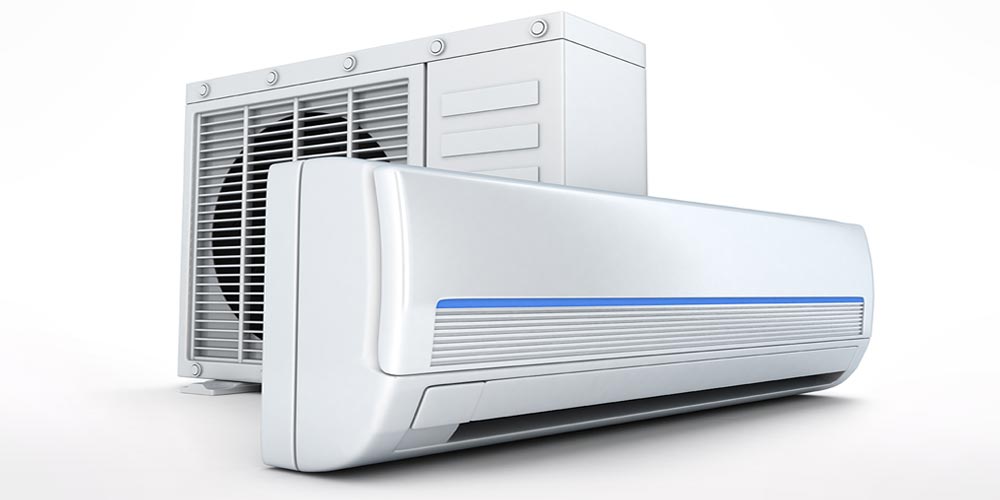
Split Air Conditioning System
Everyone likes to return home to a refreshingly cool house within the summertime ,heat and humidity. However, central air conditioning is dear , while window units are noisy and hulking . If you are thinking about a peaceful and descent way to bring cool air in to your home then split air conditioner is recommended by maximum people.
What is a Split Air Conditioner System?
A split air conditioning consists of an outside unit (outdoor) and an inside unit (indoor).
Outdoor Unit: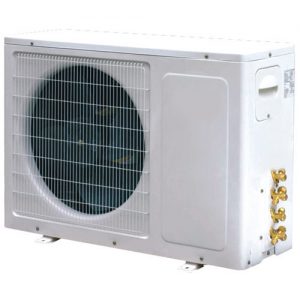
The outdoor unit is installed on or near the outside wall of the space that you simply wish to chill . This outdoor unit comprises of:
- Compressor.
- Expansion coil or capillary
- A fan for expelling out the warm air that is sucked by indoor unit.
Indoor Unit:
The sleek-looking indoor unit contains:
- Cooling coil.
- An extended blower.
- An air cleaner.
- Filters for filtering the air.
Working Principle:
The hot air is sucked by indoor unit and it is passed to the outdoor.The hot refrigerant gas absorbs this heat this heat is removed by compresses this gas by compressor and it is converted into liquid then this hot hot liquid circulates in the coils of outdoor unit or you can say it condenser and this heat is removed from that liquid by the fan present in outdoor unit as a result of this phenomenon the air inside the room becomes cool.
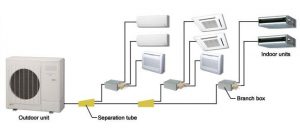
Multi Split Air Conditioning System
Ductless, Mini-Split Air Conditioners:
This is a good choice for houses that do not have ductwork. The ductless, mini-split systems combine an outside compressor and condenser with one or more indoor air-handling units. These units are mounted on the wall with blowers attached. Copper pipes attach the indoor and outdoor units and circulates refrigerant between them.
Multi Split Air conditioning System
Each room in your home will have a separate unit that cools just that room, almost like a window unit. These are often installed without tearing up walls, and permit the temperature to be controlled independently in each room. They can be more energy efficient, but are costlier if you’re cooling a whole house.
Split AC Advantage and Disadvantage
Split AC Advantage: Energy Savings
Because a number of the components are indoors, split systems offer higher energy efficiency than package units. Some Energy Star split systems offer SEER ratings above 20, which indicates superior efficiency. Pair one of these with a smart thermostat, and you’ll see major improvements in energy consumption and indoor air quality.
Split AC Disadvantage: Complex Installation
Split systems are definitely more complicated to install.
- (In Industries) Both a packaged AC and a split AC connect together with your ducts, and if your ducts are incorrectly installed, then you’ll lose efficiency and air quality. But a split system must have correct installation in two places rather than only one , creating double the quantity of chances for something to be incorrect.
- Pipes connect the outdoor unit with the indoor unit, therefore the cooled air from the compressor reaches the air handler.If these are damaged or leaked then the gas ,which is an essential component for cool air, is leaked and then system’s efficiency and working becomes zero.Though we recommend a split system by the same manufacturer, some people try to save costs by getting two different models, which may not work as harmoniously as an outdoor and an inside unit designed to travel together. Sometimes, people replace one half the split system and leave the opposite , which causes further mismatches and installation issues.
- Refrigerant lines also run between the two components. Because numerous parts need to communicate from outdoor to indoor, correct installation may be a must. If you’re inheriting an HVAC system when you buy a new property, you have no idea how it was installed or if it was done correctly. You can always call us to examine it and repair any problems, but a good installation is always the best way to ensure efficiency.
Energy Saving Features of Split Air conditioning System:
Air conditioners are cooling homes for many years , but only recently have they become significantly more efficient. There are a couple of energy-saving features that are important to seem for:
Variable speed motors:
This feature maximizes the efficiency of airflow because they’re ready to operate at multiple different speeds counting on the requirements of your system at any given time.
Automatic fan delay switch:
This enables the air handler to run a quick amount of your time after each cooling cycle so as to form use of any remaining cool air by pushing it into your home’s living spaces. This way, it’s not left sitting in the system.
Thermal expansion valves:

Expansion Valve
These valves increase the refrigerant when more cooling is required and vice versa. This allows your air conditioning to attenuate energy consumption while still keeping your home comfortable.
Tripping:
Tripping is one of the most important and extraordinary Energy saving feature. When the set temperature of your room is reached then the Split Ac unit automatically trips and compressor is turned off .When temperature increases from the set point then it again automatically switched on the compressor . This set point is fixed by your own.
Important Tips For Installation of Split Air Conditioning System:
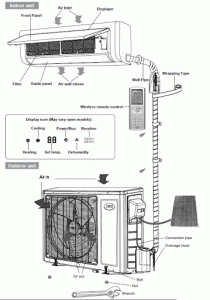
Installation of a split air conditioning is far simpler because it doesn’t require ductwork. Rather, the indoor and outdoor units are connected with a group of electrical wires and tubing.

Several factors need to considered during the installation of split air conditioning .
Strength of wall to hold the AC:
The indoor unit of split AC must be installed on a wall strong enough to carry the unit’s weight.
Proper spacing between wall and AC unit:
The indoor unit of split AC requires a minimum of 15 cm of open space surrounding its top and sides for correct air flow.
Appropriate installation height from ground:
Mount the indoor unit of split AC at a height of 7-8 feet above the bottom for adequate cooling inside the space
Correct tilt angle of indoor unit:
While fixing the aluminum bracket on wall confirm that the bracket is given a small angle , in order that the indoor unit of split AC, when fitted is additionally at a small angle to enable unrestricted flow of the condensed water from the drain pipe.
Correct location of outdoor unit:
For proper cooling, mount the indoor and outdoor units of split AC at location faraway from direct sunlight and water. Install the outdoor unit of split AC in open space in order that there’s no hindrance to the warmth dissipated from the condenser.
Proper placement of outdoor unit:
The outdoor unit of split AC must be on a hard surface or mounted on the wall. otherwise the unit will vibrate so excessively that it will cause the leakage of it’s piping. Further, the vibrating unit makes many noise which could disturb you and your neighbors.
Right distance between indoor and outdoor unit:
Correct distance between the indoor and outdoor unit plays a really important role in cooling. The coolant at very coldness flows inside the copper tubes between indoor and outdoor units of split AC. There is always some loss of cooling effect to the atmosphere when the refrigerant flows between the units.. The maximum allowable distance between the indoor and therefore the outdoor units of split AC are often about 15 meters.




1 Comment
[…] air conditioning is usually mentioned as room air conditioning also . It is the only sort of an air con system and is mounted on windows or walls. It is a single […]